


Blackthorn: the tree for all seasons
The raw power of this woodland species is literally the stuff of legends. Bristling with hostility from thorn to root, ready to serve as a tool of protection or a deadly weapon, blackthorn (Prunus spinosa) stands proud on the borderline between darkness and light.

Blackthorn is the sacred tree of Samhain, the turning point of the year we now call Halloween. The Celtic fire festival lasted three days, with blackthorn exalted in lore as the embodiment of strength and endurance at this time of challenge. In the same way, hawthorn – its sister tree – ruled the springtime feast of Beltane on 1 May. These two critical moments in the ancient calendar stand directly opposite on the wheel of the year, dividing the life-cycle in two.
The role of blackthorn in mythology is a typical Celtic blend of superstition, symbolism and physical reality. To grip a blackthorn rod or staff is to hold the very essence of winter in our fingers; to summon its strength into our selves at the moment of greatest need. It was said that a terrifying giant hag known as the Cailleach – a Crone goddess – would sound the beginning of the dark season by drumming her blackthorn staff on the ground. Cailleach was known as the taker and bringer of life.

Yet blackthorn symbolises hope as much as courage in adversity; the old year must die but the wheel of the seasons is always turning towards the new, and to rebirth at Beltane.
Although Beltane was very much a celebratory feast of fertility and sexuality, blackthorn wands were also produced in May for divination and spell-casting. A common and popular ritual was to dress bridal chambers in heavily-scented flowers of both hawthorn and blackthorn, to exploit their aphrodisiac qualities.
Across Ireland, Scotland and western England farmers wisely placed blackthorn at vulnerable entry points of their land; neither herds nor humans could expect to penetrate such a barrier without a struggle. Its famously sharp thorns were known as "witch-pins" and used to pierce dolls in spell-casting and magic rituals. Trimmed of these needle-sharp points, a blackthorn bough could be fashioned into a shillelagh – the heavyweight cudgel that settled many a boundary dispute in old Ireland.
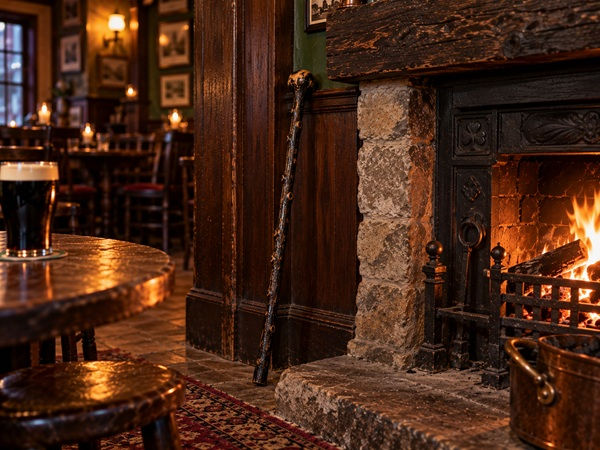
"A broken skull ensues at every stroke", wrote the poet Murrich O'Connor describing blackthorn battles of county Kerry in 1740. The ultimate blackthorn club was tempered by daubing its head in butter and storing it in a fireplace cubby hole for up to three years. According to O'Connor, a weapon produced this way "will bend with blows but never can be broke".
In the minds of the ancients, the stark profile of the blackthorn tree was a stern reminder of the fading of the light as the sun retreated from autumn skies. A blackthorn winter occurred when there was a sudden sharp return to colder temperatures in late March or early April. It was one remembered as long, grim and bitterly cold, when nature claimed a heavy toll in deaths of the weak and infirm.
Fearing both the harsh realities of wintertime and the inevitable tribal battles of summer, the Gaels were equally wary of evil spirits who targeted the dark months as a window of opportunity to work their devilry in human affairs. Once again, mortals would reach to the blackthorn for safety and reinforcement. Complex rituals surrounded every aspect of engagement with blackthorn, which could only be cut on certain sacred days and was employed in different ways for specific purposes. The blackthorn fruit proved as potent as its shoots, with the creation of sloe gin persisting into the modern era as a winter staple in farm kitchens of England and Wales.
Known as Straif in the Ogham tracts, which are the earliest known expressions of Irish script, the life of a blackthorn tree – often a century or more – was beset with danger, violence and supernatural import. But so were the lives of the peoples who revered this extraordinary organism. At every turn of the season, the keeper and increaser of dark secrets stood firm as a living inspiration to confront and confound all challenges – natural, territorial and occult.
Always stay safe when foraging. You need to be 100% sure of your identification, 100% sure that your foraged item is edible, and 100% sure that you are not allergic to it (it is good practice to always try a small amount of any new food you are consuming). If in doubt, leave it out!


